Moving Up in West Palm Beach: What a $4.7 Billion Marine Economy Means for Your Next, Bigger Boat
By Brian French | Florida Marine News — Independent editorial content
Brian French is a University of South Florida finance graduate and former Vice President and Portfolio Manager for Merrill Lynch Private Investors and Trust Investment Officer for SunTrust Bank. He analyzes Florida’s waterfront economies for the Florida Authority Network.
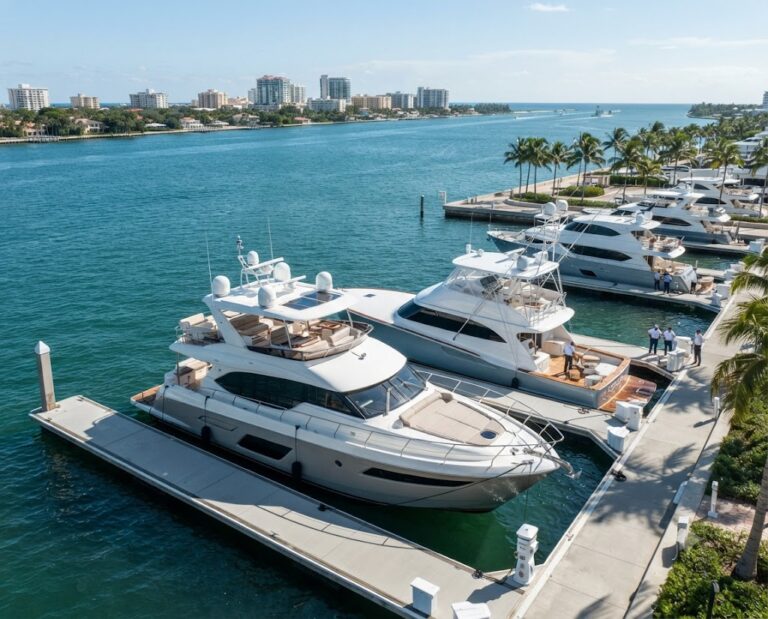
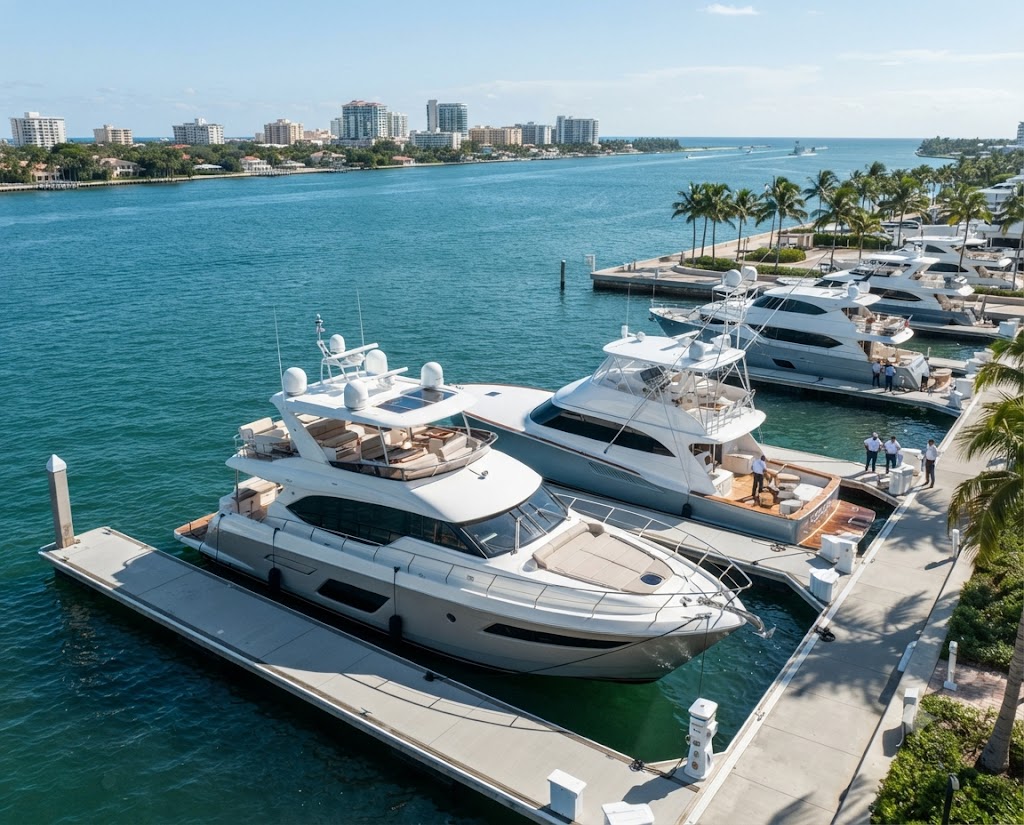
Every boat owner knows the moment. You’re rafted up at Peanut Island on a Saturday, your 42-footer feels crowded with the grandkids aboard, and a 58-foot flybridge idles past looking like it was born for exactly this water. The move-up itch is universal in boating — but acting on it wisely is not a boat decision. It’s an infrastructure decision, and nowhere in Florida is that clearer than West Palm Beach.
Most move-up advice focuses on the vessel: hull surveys, engine hours, brokerage negotiation. All necessary, all covered endlessly elsewhere. What almost nobody analyzes is the economy your bigger boat will live inside — the slips, the service yards, the labor pool, and the market calendar that will determine whether your 60-footer is a joy or a floating dispute with the local infrastructure. Palm Beach County publishes more hard data on its marine economy than almost any boating market in America, and read correctly, that data amounts to a buyer’s guide no brokerage will hand you.
So let’s read it the way an analyst would: not “which boat,” but “what does this market let you own well.”
How Big Is the West Palm Beach Marine Economy, Really?
Big enough to function as a self-contained industry — and that scale is precisely what a move-up buyer is purchasing access to. According to the economic impact study conducted by Thomas J. Murray & Associates for the Marine Industries Association of Palm Beach County, the marine industry generates an overall economic impact of $4.7 billion annually in Palm Beach County and supports approximately 22,000 jobs. Zoom out to the tri-county region (Palm Beach, Broward, Miami-Dade) and the 2022 study puts the figure at $18.5 billion and roughly 141,000 jobs, with Florida’s statewide marine-related sales reaching $7.19 billion — about 38% of the national total flowing through one state.
West Palm Beach Marine Economy: By the Numbers
| Metric | Figure | Source |
|---|---|---|
| Countywide economic impact | $4.7 billion / year | MIAPBC (Murray study) |
| Marine industry jobs, Palm Beach County | ~22,000 | MIAPBC |
| Registered boats, Palm Beach County | ~37,000 | MIAPBC / Murray 2022 |
| Total market value of county boat slips | $436 million | Business Development Board of PBC |
| Appraised value, marinas & boatyards | $78.4 million | Business Development Board of PBC |
| Service-sector share of impact | Over 50% (~$1B+ sales, 9,885 jobs) | Business Development Board of PBC |
| Tri-county regional impact | $18.5 billion / 141,000 jobs | MIASF 2022 study |
| Palm Beach International Boat Show impact | $1.05 billion statewide | MIAPBC |
Two numbers in that table matter more to a move-up buyer than all the others combined, and neither is the headline figure. They’re the $436 million slip valuation and the service sector’s greater-than-half share of the whole economy. The rest of this article is about why.
Brian’s Take: Headline economic-impact numbers are marketing; composition is analysis. When more than half of a $4.7 billion marine economy is service — not boat sales — the market is telling you what it’s actually good at: keeping large, complex vessels running. For a buyer stepping up in size, that’s the single most reassuring statistic in the county, because at 60 feet you’re not buying a boat so much as subscribing to a maintenance ecosystem. West Palm has one of the deepest in the country.
Why Does Slip Scarcity Matter More as Your Boat Gets Bigger?
Because dockage is the one input that doesn’t scale with demand. Palm Beach County has roughly 37,000 registered boats — a figure the Murray study shows grew about 3% between study periods — competing for a finite inventory of wet slips whose total market value the county’s Business Development Board pegs at $436 million. Boats can be manufactured; protected deepwater frontage on the Intracoastal cannot. That asymmetry is invisible at 30 feet, noticeable at 45, and decisive above 55 — because as length, beam, and draft grow, the fraction of existing slips that can physically take your boat shrinks fast, and you graduate from “renting a parking space” to “competing for scarce industrial real estate.”
The top of the market shows what the county’s infrastructure can do. Safe Harbor Rybovich — the storied yard founded in 1969, acquired by Safe Harbor Marinas in 2020 — berths yachts up to 100 meters (328 feet) with 18-foot approach depths and unobstructed access through the Lake Worth Inlet, backed by more than 20 acres of service and refit capacity. Facility listings show a slip inventory measured in the dozens, not the hundreds — Waterway Guide records 60 slips with 20 transient. That is world-class capability and boutique quantity in the same sentence, and it describes the county’s dockage market in miniature: extraordinary at the top, tight everywhere.
What does a slip actually cost? Here the honest answer is that this market doesn’t publish it. Premium facilities quote dockage individually, and posted figures go stale quickly — one marina directory recorded transient rates at Rybovich of $3.75 per foot per day back in 2019, and current membership and annual arrangements are quote-based. Treat any specific number you read online, including that one, as a historical data point rather than a price sheet, and treat the absence of posted pricing as its own signal: sellers who don’t publish prices are sellers with pricing power.
Brian’s Take: Buy the slip before the boat — or at minimum, secure it in writing simultaneously. In a county where the entire slip inventory carries a $436 million valuation against 37,000 registered vessels and a growing megayacht presence, dockage is the appreciating asset and the boat is the depreciating one. I watched clients in my banking years finance the depreciating half of a transaction meticulously while treating the scarce half as an afterthought. In this market, that’s exactly backwards.
What Actually Constrains a Move from 45 to 60 Feet Here?
Not the purchase price — capacity. The county’s own data says the marine economy’s center of gravity is service: over $1 billion in annual business sales, $369 million in personal income, and 9,885 jobs in the service sector alone, per the Business Development Board’s summary of the industry studies. That workforce — technicians, riggers, electricians, canvas shops, detailers, captains — is the real constraint market a move-up buyer enters, because a 60-footer roughly doubles the systems complexity of a 45: generators, stabilization, watermakers, sophisticated electronics, and hydraulics that turn “I’ll fix it Saturday” into “who can I get, and when.”
The county’s advantage is that this labor pool exists at scale, anchored by refit infrastructure — Rybovich’s yard, the Riviera Beach facilities with a floating dry dock rated for vessels up to 90 meters — that most American boating markets simply do not have. The buyer’s reality is that you’re sharing it: with 204 marine companies operating countywide and a superyacht clientele whose refit budgets set the pace, scheduled maintenance becomes something you book the way you book a good restaurant, in advance and with relationships. The move-up boater’s most valuable acquisition after the slip isn’t equipment — it’s a standing relationship with a yard and a service manager who answers your calls.
Budget structure changes too, and honesty requires saying what the data doesn’t: nobody publishes a reliable “cost of ownership” table for this market, and the rules of thumb thrown around boating forums (annual costs as a percentage of hull value) are folklore, not measurement. What the county’s numbers do tell you is directional: an economy where service is more than half of $4.7 billion is an economy where owners spend heavily and continuously after the purchase. Even the small numbers rhyme with that: the Murray research found boaters spend about $52.97 per outing on incidentals — fuel, food, ice — before a single invoice from the yard. Size that up mentally by a factor appropriate to sixty feet and crew, and you have the honest shape of the commitment.
Brian’s Take: In my portfolio-management years, the clients who were happiest with illiquid assets were the ones who’d budgeted for the carry, not just the acquisition. A bigger boat is an illiquid asset with a heavy carry, in a service market with visible pricing power. My rule for the move-up: if the annual operating budget — dockage, service, insurance, crew, the incidentals — would strain you at double your current boat’s figure, buy the smaller boat and the better slip. The county’s service depth means everything is fixable here. It does not mean it’s cheap.
When Is the Best Time to Buy — and What Does the Boat Show Have to Do With It?
March — or more precisely, the weeks around the Palm Beach International Boat Show, when the entire market comes to you. The show, staged along Flagler Drive downtown, ranks among the top five largest boat shows in the United States, draws more than 55,000 attendees, and carries a statewide economic impact of $1.05 billion according to the Marine Industries Association of Palm Beach County. For a move-up buyer, its value isn’t the ticket price of anything on display — it’s compression: hundreds of exhibitors, the brokerage community, the service vendors, and the comparable-boat market all within a mile of waterfront for four days.
The strategic use of the show isn’t to buy at it; it’s to calibrate. Walk the size class above your target and the one below. Board everything. Collect the brokers who listen more than they pitch. Then work the months after, when show-season energy meets sellers whose boats didn’t move. And use the show for the unglamorous half of the transaction: the slip conversations, the yard introductions, the insurance broker meetings that determine whether the boat you fall for can actually live here on terms you can hold. The show puts the county’s entire $4.7 billion ecosystem in one place once a year. Buyers who treat it as infrastructure reconnaissance rather than a shopping trip come out ahead.
Brian’s Take: Markets with annual gathering points develop annual rhythms, and disciplined buyers exploit rhythm. My calendar for a Palm Beach move-up: attend the March show to calibrate and build the relationship map; survey and negotiate in the unfashionable months; close with the slip and service relationships already secured; and be on the water by season. The worst outcome isn’t overpaying for the boat — boats are negotiable. It’s owning the right boat with nowhere good to keep it and no one available to fix it. In this county, the infrastructure is the luxury. The boat is just the ticket in.
The Bottom Line
West Palm Beach offers the move-up buyer something rarer than beautiful water: a documented, deep, professionally studied marine economy — $4.7 billion, 22,000 workers, world-class refit capacity — that can genuinely support ownership at the next size class. The same data that proves the depth also maps the constraints: scarce dockage carrying real pricing power, a service sector whose capacity you share with the biggest yachts in the hemisphere, and a market calendar that rewards buyers who move deliberately. Read the county’s numbers before you read a single listing. The boat is the easy part.
Frequently Asked Questions
How many boats are registered in Palm Beach County? Approximately 37,000, according to the Marine Industries Association of Palm Beach County — against roughly 1 million registered statewide.
What is the largest yacht facility in West Palm Beach? Safe Harbor Rybovich, founded 1969, which berths yachts up to 100 meters (328 feet) with 18-foot approach depths and operates more than 20 acres of service and refit facilities, plus Riviera Beach capacity including a floating dry dock rated to 90 meters.
When is the Palm Beach International Boat Show? Annually in late March along Flagler Drive in downtown West Palm Beach. It ranks among the five largest boat shows in the U.S., draws 55,000+ attendees, and generates an estimated $1.05 billion statewide economic impact.
How much does a boat slip cost in West Palm Beach? The market doesn’t publish standardized rates — premium facilities quote individually, and posted figures date quickly. Countywide, boat slips carry a total market value of $436 million, and scarcity gives facilities meaningful pricing power, particularly above 55 feet. Get quotes in writing early in your search, not after you’ve chosen the boat.
Sources
- Marine Industries Association of Palm Beach County, “Industry Impact” (Thomas J. Murray & Associates economic impact study) — marinepbc.org/industry-impact
- Thomas J. Murray & Associates, Inc., “Recent Growth and Economic Impact of the Recreational Marine Industry in Southeast Florida’s Tri-County Region — 2022” — marinepbc.org
- Business Development Board of Palm Beach County, “Marine Industries” — bdb.org/industries/marine-industries
- Marine Industries Association of South Florida, “Economic Impact of the Recreational Marine Industry — Broward, Miami-Dade, and Palm Beach Counties” (2022) — miasf.org/about/library
- Safe Harbor Marinas, “Safe Harbor Rybovich” facility information — safeharbor.com/locations/safe-harbor-rybovich; supplemental facility data via Waterway Guide
- Marine Industries Association of Palm Beach County, Palm Beach International Boat Show economic impact reporting — marinepbc.org
This article is independent editorial content of Florida Marine News, a Florida Authority Network publication. It is general market analysis, not financial, legal, or purchase advice; consult qualified marine, financial, and insurance professionals before any vessel transaction. Figures are drawn from the cited studies and current as of their publication dates.
About the Author