By Brian French, founder and publisher, Florida Authority Network
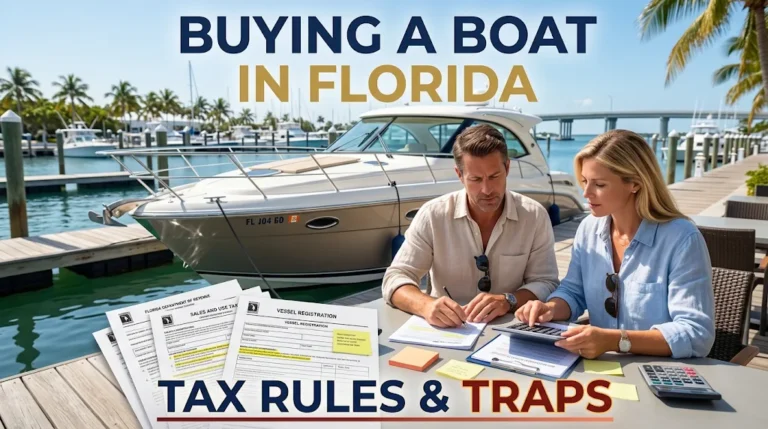
Florida is one of the best places in the country to buy a boat, partly because of its enormous inventory and partly because of a tax rule that is unusual in the marine world. The state charges a 6 percent sales and use tax on vessels, but caps the total tax on any single boat at $18,000. For buyers of expensive yachts, that cap can save tens or hundreds of thousands of dollars. It also attracts scrutiny, because the rules around the cap, the exemptions and the proof required to claim them are technical, and mistakes can lead to assessments, penalties and interest.
This guide explains how the Florida boat tax works, where buyers most often go wrong, and what documentation matters. It relies on Florida Department of Revenue publications and on commentary from Florida sales tax practitioners and yacht brokers. It is general information, not tax or legal advice. Because the rules are fact-specific, anyone buying a significant vessel should consult a maritime attorney or a Florida sales tax professional before closing.
The Basics: Florida Sales and Use Tax on Vessels
Florida imposes a 6 percent state sales and use tax on the purchase of a boat. Sales tax applies when a vessel is sold in Florida, and use tax applies when a vessel is purchased elsewhere and then brought into the state for use or storage. In most counties, a discretionary sales surtax also applies, which is why buyers may see a combined rate that is slightly higher than 6 percent on the first portion of the price. The Department of Revenue publishes the surtax rates for each county, and its form DR-15DSS lists them.
When you buy from a licensed Florida dealer, the dealer is generally required to collect the tax and remit it. When you buy from a private seller, or when you buy outside Florida, the buyer is responsible for reporting and paying use tax, typically when titling or registering the boat. The statutory basis is Section 212.05 of the Florida Statutes.
The $18,000 Tax Cap Explained
Effective July 1, 2010, the Department of Revenue states, the maximum tax on the sale or use of a boat or vessel is $18,000. The cap includes both the state sales or use tax and any applicable discretionary sales surtax. No more than $18,000 in total tax is due on any taxable sale or use. The Department has also said the cap applies to leases of boats and vessels.
Because 6 percent of $300,000 equals $18,000, the cap effectively starts to bind at a purchase price around $300,000. A buyer of a $300,000 vessel and a buyer of a $30 million yacht both reach the same ceiling. A $1 million boat bears $18,000 in tax instead of the $60,000 that a straight 6 percent would produce.
| Purchase price | 6% state tax before cap | Tax after cap (state portion) | Effective rate |
|---|---|---|---|
| $50,000 | $3,000 | $3,000 | 6.0% |
| $100,000 | $6,000 | $6,000 | 6.0% |
| $300,000 | $18,000 | $18,000 | 6.0% |
| $500,000 | $30,000 | $18,000 | 3.6% |
| $1,000,000 | $60,000 | $18,000 | 1.8% |
The table shows the state portion only. Surtax is counted inside the same $18,000 limit, so a buyer in a county with a surtax still cannot owe more than the cap in total. Examples are illustrative, and your actual bill depends on county rules, trade-ins and other factors.
Why the cap exists
The cap was designed to keep high-end boat sales in Florida. A report published by a Florida yacht broker, summarizing research on the policy, stated that the cap generated more than $13.46 million in direct sales tax revenue in its first year, while a legislative staff analysis had projected a loss of $1.5 million. The same report said transactions in which no sales tax was paid or the closing was conducted out of state fell from 21.5 percent before the cap to an estimated 12.8 percent afterward. Whatever one thinks of the policy, it made compliance easier for many buyers and kept more of the industry’s activity in Florida.
Buying Out of State and Bringing the Boat to Florida
The most nuanced area of Florida boat tax is the purchase of a vessel in another state. If you buy a boat elsewhere and then keep or use it in Florida, use tax may apply. The Department’s guidance indicates that a credit is generally available for sales or use tax properly paid to another state, but the credit is limited to the amount of tax due in Florida, and it requires proof that the tax was paid. For example, if the other state’s rate is lower than Florida’s, Florida use tax may be due on the difference, subject to the cap.
Keep proof of payment
Keep the bill of sale, the closing statement and the receipt or other evidence showing the other state’s tax was paid. A Florida sales tax practitioner has cautioned that while the Department “should” credit tax paid to another state, there are caveats, so documentation is critical.
Timing for reporting
Older consumer guidance states that use tax on a boat bought out of state is due within 90 days of the boat entering Florida, and that tax on an in-state purchase is due within 30 days. Because timing rules and forms can change, confirm the current deadlines with the Department of Revenue or the county tax collector handling your title and registration.
The Nonresident Exemption and the “90-Day” Rule
One of the most commonly discussed exemptions is the nonresident removal exemption. In general terms, a person who is not a Florida resident can buy a boat from a Florida dealer or broker without paying Florida tax if the boat is removed from the state within a limited time and the buyer meets documentation requirements. The Department publishes a brochure, GT-800005, for boat owners and purchasers, a companion document for dealers and brokers, and a suggested affidavit format.
Who qualifies
The Department’s materials say the exemption does not apply to a Florida resident, or to an entity in which the controlling person is a Florida resident. A Florida sales tax firm has also emphasized that the purchase must be made through a registered Florida dealer or broker and that all required paperwork must be completed. In other words, the exemption is available to residents of anywhere but Florida, and it is not available to a Florida resident who simply routes a purchase through an out-of-state company.
Time limits and decals
The popular shorthand is a 90-day rule, and Department guidance does describe Florida boat decals that authorize a boat to remain in Florida waters for up to 90 days after purchase, with an extension available in some circumstances. Other commentary describes a requirement that the boat be removed within 90 days and not return for six months, and describes shorter windows in certain dealer-delivery situations. Because the specifics vary by transaction, never rely on a headline number. Review the current Department publications and have the dealer, broker and your advisor confirm the exact time limits that apply to your purchase.
Documentation commonly required
- A signed affidavit or certification by the purchaser.
- The invoice and bill of sale.
- Proof that the vessel left Florida, such as fuel receipts, marina receipts or logs showing the route.
- Documentation of registration or titling outside Florida.
- Department decals displayed as required while the boat remains in Florida.
The Department states that if a purchaser fails to comply with the exemption requirements, the maximum tax due is the $18,000 cap, and failure to comply may result in penalties. For dealers, the stakes are even higher. The Department’s guide for dealers and brokers warns that a dealer who does not maintain proper records to prove an exemption will owe tax, penalty and interest on each transaction.
Corporate Structuring: LLCs and Holding Entities
Many boat owners hold vessels in a limited liability company or other entity for liability protection, estate planning or privacy. These are legitimate reasons, and Florida marine attorneys regularly set up single-vessel LLCs. But the structure has tax implications. As the Department’s materials note, the nonresident exemption does not apply where the controlling person of an entity is a Florida resident. That means an LLC formed in another state but controlled by a Florida resident will generally not qualify.
Other points to review with counsel include where the entity is organized, who the managers and members are, where the vessel will be kept, how it will be documented or registered, and what insurance requirements apply. An entity must also respect formalities, such as keeping separate accounts and signing contracts in the entity’s name, to maintain liability protection. This article does not provide legal advice, but the main point is that structure should be designed with the tax rules in mind and not as an afterthought.
Registration and Documentation
Buying the boat is only the first step. In Florida, vessels used on state waters generally must be titled and registered, and registration is handled through the county tax collector and the state motor vehicle agency. Larger vessels may also be documented with the U.S. Coast Guard, which is a federal process with its own requirements, and documented vessels still typically need state registration. Federal documentation can matter for financing and for international cruising, so discuss it with your broker or attorney.
Avoiding Audit Triggers
Audit activity in this area often focuses on a few recurring patterns. Understanding them helps buyers and dealers avoid trouble.
- Out-of-state closings with thin paperwork. A closing held outside Florida for a boat that is physically in Florida invites questions. Keep documents that explain where title passed and where the vessel was delivered.
- Residency inconsistencies. If a buyer claims nonresident status but has a Florida driver license, homestead exemption, voter registration or a Florida address on insurance and registration documents, the claim is vulnerable.
- Boats that stay too long. A vessel that remains in Florida waters beyond the permitted period, or returns too soon, may lose its exemption.
- Missing proof of removal. If you cannot show that the boat left the state, you may not be able to defend the exemption.
- Use tax not reported. Out-of-state purchases brought into Florida without use tax reporting are a common source of assessments.
- Inaccurate sale price. Bills of sale that do not reflect the real transaction, including add-ons and equipment sold with the boat, can be challenged.
The best protection is a paper trail. Keep copies of every contract, receipt, affidavit and log, and maintain them for the period recommended by your advisor.
A Practical Buyer’s Checklist
- Decide whether you are a Florida resident for tax purposes, and understand what that means before you shop.
- Use a licensed Florida dealer or broker if you plan to rely on the nonresident exemption.
- Ask the dealer to explain the tax calculation and exemption paperwork in writing.
- If you are buying out of state, collect proof of tax paid and ask about Florida credit and filing.
- Review entity structure with an attorney before the contract is signed.
- Confirm current deadlines, forms and rates with the Department of Revenue.
- Store your documents and logs securely.
Florida’s boat tax cap is a genuine advantage, but it rewards buyers who treat compliance as part of the purchase process. The cost of a good adviser is small compared with a surprise assessment on a seven- or eight-figure vessel.
Frequently Asked Questions
What is the maximum sales tax on a boat in Florida?
The Florida Department of Revenue states that the maximum tax on the sale or use of a boat or vessel is $18,000, including both state tax and discretionary sales surtax.
At what price does the Florida boat tax cap start to apply?
At about $300,000, because 6 percent of $300,000 equals $18,000. Above that, the tax stays at the cap.
Do I owe Florida tax if I buy a boat in another state?
Possibly. Use tax may apply when a boat purchased elsewhere is brought into Florida for use or storage. A credit may be available for tax properly paid to another state, up to the Florida amount.
Can a Florida resident use the nonresident exemption?
No. The Department’s materials say the exemption does not apply to a Florida resident or to an entity whose controlling person is a Florida resident.
How long can a boat stay in Florida under the nonresident exemption?
Department guidance describes decals that allow a boat to remain for up to 90 days after purchase in some cases, but other timing rules and extensions exist. Confirm the exact limits for your transaction.
Does the cap apply to boat leases?
The Department has stated that the $18,000 maximum also applies to the lease of a boat or vessel.
About the Author
Brian French is the founder and publisher of the Florida Authority Network, a collection of more than 35 Florida business news, industry, video and press release publications. His career before publishing was in finance: he served as a Vice President and Trust Officer at both Merrill Lynch and SunTrust, and as a Portfolio Manager at Merrill Lynch Trust Company and Merrill Lynch Investment Managers – Private Investors. Earlier, he was a Financial Advisor at Shearson American Express and E.F. Hutton and a Common Stock Analyst at Independence Securities in Greensboro, North Carolina. He passed Level II of the CFA Program. Brian lives near Tampa, Florida, with his wife.
This article is general information for Florida boaters and marine businesses. It is not legal, tax, insurance or investment advice. Confirm current rules, fees and dates with the responsible agency or a licensed professional before you act.
Sources and Further Reading
- Florida Department of Revenue, Tax Information Publication TIP 10A01-07, Sales and Use Tax on Boats or Vessels Capped at $18,000
- Florida Department of Revenue, GT-800005, Sales and Use Tax on Boats: Information for Owners and Purchasers
- Florida Department of Revenue, GT-800006, Sales and Use Tax on Boats (nonresident exemption)
- Florida Department of Revenue, Sales and Use Tax on Boats: Information for Dealers and Brokers
- Florida Statutes, Section 212.05 (sales, storage, use tax)
- Denison Yacht Sales, Florida’s Boat Sales Tax Cap (June 2026)
- Denison Yacht Sales, Report: 2010 Florida Boat Tax Cap Proven Successful (March 2012)
- Florida Sales Tax (floridasalestax.com), Buying a Boat in Florida: Out-of-State Sales Tax (May 2019)
- Florida Sales Tax (floridasalestax.com), Florida Sales Tax on Boats Dealer Guide (May 2023)
- Florida Sales Tax (floridasalestax.com), Florida Sales Tax on Licensed Saltwater Fishing Boats (August 2024)
- Murray Yacht Sales, Gulf Coast States Sales and Use Tax on Vessels
- Legal Beagle, Florida Boat Sale Laws
About the Author