By Brian French, founder and publisher, Florida Authority Network
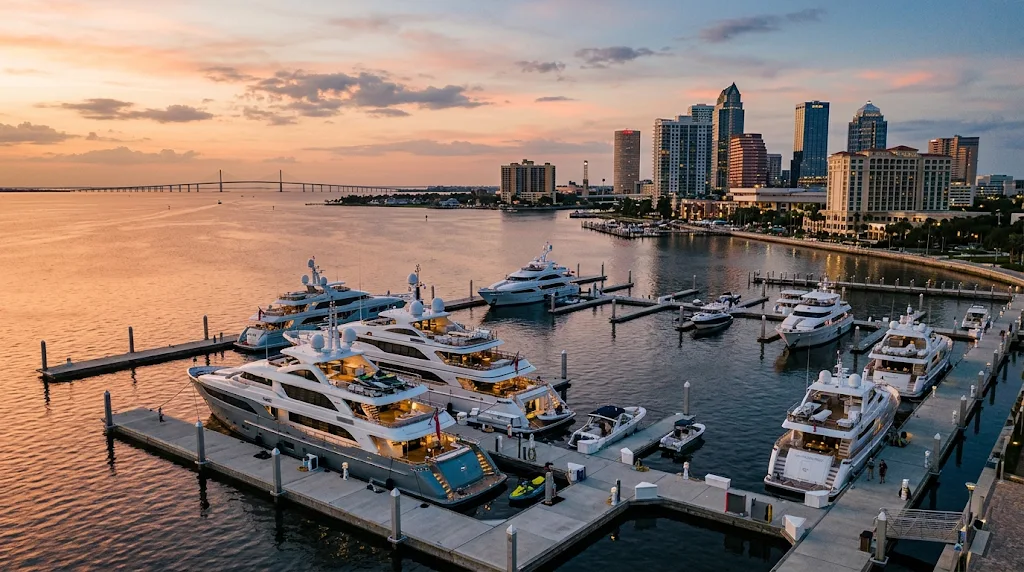
For decades, Tampa Bay was known primarily as a regional boating market with a large fleet of center consoles, sailboats and fishing boats, plus a major commercial port. That description is getting out of date. Over the past two years, a cluster of projects has pushed the Bay toward something larger: a Gulf Coast hub where big yachts can find slips, repair yards, cruise-ready port infrastructure and quick access to open water. The story is not a single megaproject. It is a series of public and private investments, from new megayacht slips in downtown St. Petersburg to a federal grant for a Tampa shipyard and a multi-year navigation improvement program at Port Tampa Bay.
Brian French, founder and publisher of the Florida Authority Network, lives near Tampa, and the changes now underway on the Bay’s waterfront deserve a careful look from owners, captains, brokers and investors. This article reviews what has been announced, what is built, what is still planned, and what the distinction means for anyone considering the Bay as a home port or refit location.
Why Tampa Bay Is Drawing Larger Vessels
Several factors are converging. Tampa Bay has deep, protected water, a working port with decades of shipyard experience, a skilled marine workforce, and a coastline on the Gulf of Mexico that opens to cruising grounds many Atlantic-side owners rarely visit. It also offers a very different cost and congestion profile than South Florida’s busiest yacht centers. For owners of larger vessels, availability of slips, haul-out capacity and trained subcontractors often matters more than the glamour of an address, and Tampa Bay is expanding exactly those capabilities.
It is also a place where the commercial and recreational sides of the waterfront overlap. Port Tampa Bay describes itself as a cargo gateway, a cruise homeport and a ship repair center, and federal officials have stressed its potential as a shipping hub for the Caribbean and Asia if planned extensions and dredging projects are completed. The yachting sector benefits when the same deep-water and repair assets that serve commercial vessels are also available to large pleasure craft, provided the facilities are managed so the two uses can coexist.
Port Tampa Bay: Deep-Water Access and a Multi-Year Build-Out
Port Tampa Bay handles more than 30 million tons of cargo a year. Several of its current projects are aimed at larger commercial vessels, but their effects reach the broader maritime economy.
Berth 300 and the Tampa Harbor Navigation Improvement Project
In 2026, the port announced a federal investment of about $24 million, paired with $16 million from the port itself, for a $40 million expansion of Berth 300. The plan is to extend the berth by 800 feet, creating a 1,300-foot berth and about 2,800 feet of contiguous berth space. Separately, the Tampa Harbor Navigation Improvement Project, authorized by Congress in late 2024, has been described as the largest infrastructure initiative in the port’s history, and the port received a further $10 million federal investment in April 2026 to support it.
For yacht owners, these numbers matter less as dollars than as signals. They show that the channel, berth and dredging capacity of the Bay is being treated as a long-term strategic asset. Deeper, better-maintained commercial channels make it easier for the port to compete for large vessels and ship repair work, and they tend to support the supporting trades that also serve yachts.
Cruise terminal upgrades
The cruise side of the port is also growing. Port Tampa Bay completed installation of three new passenger boarding bridges, announced in June 2026, and trade reporting describes work on the port’s first new cruise terminal in 25 years. Cruise traffic does not directly create yacht slips, but it increases the port’s activity, funding base and political support for waterfront infrastructure, and it is a reminder that yacht operations will need to work around large commercial schedules.
St. Petersburg: Megayacht Slips and a New Port Master Plan
If Tampa is the working port, St. Petersburg is the yachting showcase. The city’s downtown waterfront has long attracted visiting boats, and recent projects are expanding the range of vessels it can serve.
Harborage Marina at Bayboro
Construction is complete on seven megayacht slips at Harborage Marina at Bayboro. Trade reporting describes the extension as including four side-tie moorings, providing seven slips, for yachts as large as 200 feet, along with 10 additional slips for vessels as large as 60 feet. That mix is important. Megayacht berths bring visibility and revenue, while the smaller slips preserve the marina’s usefulness for the region’s much larger population of ordinary owners.
The Port of St. Petersburg master plan
St. Petersburg City Council unanimously approved a new master plan for the Port of St. Petersburg that outlines an estimated $93 million to $163 million in potential improvements over the next 10 to 20 years. The plan replaces one adopted in 1999 and covers a roughly four-acre port on the downtown waterfront near the University of South Florida St. Petersburg campus. Reported elements include expanded marine research facilities, boat repair operations, new infrastructure for small cruise ships and illustrations of recreational boating facilities and a superyacht marina. At least one council member questioned how the recreational and superyacht illustrations fit with the technology hub where waterfront access is needed for research, a reminder that the plan is a framework and not a final design.
Another project listing noted that, as of March 2026, the master plan was still being finalized and was expected to be completed by the end of 2026. Anyone considering the St. Petersburg port as a future home for a large yacht should treat it as a long-range opportunity rather than a near-term slip. The Florida Ports Council has described Port St. Pete as the only superyacht marina on Florida’s Gulf Coast, and new capacity such as Harborage’s extension may change that picture over time.
Refit and Maintenance Yards
A yacht is only as useful as the yard that can maintain it. Tampa Bay’s repair capacity is a reason owners consider it for long-term homeports.
Federal support for Tampa shipyards
U.S. Transportation Secretary Sean Duffy visited Port Tampa Bay to announce an approximately $1 million Small Shipyard Grant for Gulf Marine Repair, a Tampa-based company. Officials described the port as a shipyard center with the workforce and platform to grow, and the same visit highlighted $16.5 million in funding for a new 249-passenger ferry for the Pinellas Suncoast Transit Authority’s planned Tampa Bay Ferry service, with Hubbard’s Marina set to operate the initiative. Officials did not provide a construction timeline for the ferry or the shipyard upgrades.
Marina-based services and dry storage
On the recreational side, Port 32 Tampa illustrates how Bay marinas are rebuilding and expanding. The marina, near the mouth of Old Tampa Bay, added new floating concrete docks and an upgraded wave attenuator after Hurricane Helene and now offers 607 dry slips and 15 wet slips, with direct access to both Tampa and St. Petersburg. That sort of resilient design is increasingly what insurers and owners expect.
When evaluating a refit yard for a large vessel, ask for the following:
- The maximum length, beam, draft and weight the lift or railway can handle.
- Whether the yard is open to outside contractors or requires in-house labor.
- The yard’s hurricane haul-out policy and priority system.
- References from owners of similar vessels and recent project timelines.
- Insurance requirements for contractors working aboard.
The Gulf Coast Cruising Corridor
The Bay’s appeal for yachts is not just infrastructure. It is also the cruising grounds. From Tampa Bay, a captain can head south to the barrier islands and coastal waters of Southwest Florida, north toward the Nature Coast, or offshore into the Gulf. Clear-water anchorages, sandbars and island stops are within a day’s run, and the Intracoastal Waterway runs inside the barrier islands for shallower-draft vessels.
Air draft deserves special attention. The Sunshine Skyway Bridge crosses the mouth of the Bay with a vertical clearance of roughly 175 feet, which accommodates most yachts but should still be verified against the actual height of a vessel’s mast, radar arch or antennas, especially for sailing yachts and tall sportfishers. Other bridges inside the Bay and along the Intracoastal Waterway are much lower, and many operate on schedules.
Key Projects Snapshot
| Project | Location | Reported detail |
|---|---|---|
| Berth 300 expansion | Port Tampa Bay | $24M federal plus $16M port; extends berth by 800 feet |
| Tampa Harbor Navigation Improvement Project | Port Tampa Bay | Authorized late 2024; $10M federal investment April 2026 |
| Passenger boarding bridges | Port Tampa Bay | Three new bridges completed, announced June 2026 |
| Gulf Marine Repair grant | Tampa | About $1M Small Shipyard Grant |
| Harborage Marina extension | St. Petersburg | Seven megayacht slips for yachts up to 200 feet |
| Port of St. Petersburg master plan | St. Petersburg | $93M to $163M potential improvements over 10 to 20 years |
| Port 32 Tampa rebuild | Tampa | 607 dry slips, 15 wet slips, new floating docks |
The Investment Landscape
Investors tend to ask whether a hub like this translates into real estate and business opportunity. The evidence so far points to opportunity with caveats. Public funding, federal grants and private marina investments show momentum. But large master plans take years to finalize, fund and build, and the details can change through public comment, environmental permitting and shifting political priorities. A rendering is not a building permit.
For buyers of waterfront property with a private slip, the key questions are practical. How deep is the water at the dock at low tide? What is the air draft under bridges between the property and open water? Does the community’s seawall and dock meet current standards? Is there a homeowners association with rules about vessel size or liveaboards? And how does insurance treat the property and the vessel in a named storm? These questions matter more than the broader hub narrative.
For operators and service businesses, the Bay’s growth suggests demand for skilled trades, from marine electricians and fabricators to painters and project managers. Operators should watch for procurement notices from the port and the city, and for opportunities connected to ferry service and shipyard expansion.
What Owners and Captains Should Do Now
- Verify current slip availability and maximum vessel dimensions directly with marinas, since announcements and reality can differ.
- Check air draft, channel depth and bridge schedules for your intended routes.
- Interview yards early and ask for project timelines in writing.
- Review your hurricane plan, including haul-out options and insurance requirements.
- Follow city council and port commission agendas for master plan updates.
Tampa Bay is not yet a replacement for the established yacht centers on Florida’s Atlantic coast, and it does not need to be. Its advantage is that it is becoming a credible, well-funded alternative on the Gulf, with a working port, expanding slips and a growing repair base. The opportunity is real for owners who do their homework and are willing to watch projects move from plan to pilings.
Frequently Asked Questions
Can Tampa Bay handle superyachts?
Yes, within limits. Harborage Marina at Bayboro in St. Petersburg has completed slips for yachts as large as 200 feet, and Port Tampa Bay has deep-water berths and shipyard capacity, though slip availability and dimensions should be verified directly.
What is the Port of St. Petersburg master plan?
It is a plan approved by St. Petersburg City Council that outlines an estimated $93 million to $163 million in potential improvements over 10 to 20 years, including marine research, boat repair and small cruise ship facilities. Details were still being finalized as of 2026.
What is the Tampa Harbor Navigation Improvement Project?
It is a Congress-authorized program described as the largest infrastructure initiative in Port Tampa Bay’s history, and the port received a $10 million federal investment toward it in April 2026.
How tall a vessel can pass under the Sunshine Skyway Bridge?
The bridge has a vertical clearance of roughly 175 feet, but captains should confirm current clearance and their own air draft before transiting.
Is Port 32 Tampa a wet slip or dry stack marina?
It is mostly dry stack. Reporting in 2026 listed 607 dry slips and 15 wet slips, along with new floating concrete docks.
Are the new Tampa Bay projects finished?
Some are, such as the Harborage megayacht slips and the Port 32 rebuild. Others, including the St. Petersburg master plan and shipyard upgrades, are still in planning or early stages.
About the Author
Brian French is the founder and publisher of the Florida Authority Network, a collection of more than 35 Florida business news, industry, video and press release publications. His career before publishing was in finance: he served as a Vice President and Trust Officer at both Merrill Lynch and SunTrust, and as a Portfolio Manager at Merrill Lynch Trust Company and Merrill Lynch Investment Managers – Private Investors. Earlier, he was a Financial Advisor at Shearson American Express and E.F. Hutton and a Common Stock Analyst at Independence Securities in Greensboro, North Carolina. He passed Level II of the CFA Program. Brian lives near Tampa, Florida, with his wife.
This article is general information for Florida boaters and marine businesses. It is not legal, tax, insurance or investment advice. Confirm current rules, fees and dates with the responsible agency or a licensed professional before you act.
Sources and Further Reading
- Tradeonlytoday, Harborage Marina extension, St. Petersburg (side-tie moorings and slips for yachts up to 200 feet)
- Southern Boating, Megayacht Docking Comes to St. Petersburg (Harborage Marina at Bayboro)
- St. Pete Catalyst, What Does the Future Hold for St. Pete’s Working Port?
- ConstructConnect, Port of St. Petersburg Waterfront Redevelopment project listing (March 2026)
- Florida Ports Council, Port St. Pete profile
- Englewood Review, Tampa Bay Gets $24M ‘Berthday’ Present to Make Room for More Big Ships (May 7, 2026)
- MarineLink, Port Tampa Bay Receives $10M Federal Investment to Strengthen Supply Chain, Regional Economy (April 9, 2026)
- Maritime Professional, Port Tampa Receives Federal Investment
- FOX 13 Tampa Bay, U.S. Transportation Secretary Sean Duffy Announces Port Tampa Bay Investment
- St. Pete Catalyst, U.S. Transportation Secretary Discusses Port Tampa Bay Investment
- WWSB (MySuncoast), Port Tampa Bay Continues Expansion for Cruise Ship Operations (June 17, 2026)
- Seatrade Cruise News, Tampa Begins Work on First New Cruise Terminal in 25 Years
- Business Observer Florida, Tampa Marina Expands, Adds Floating Docks, Slips (June 2, 2026)
About the Author