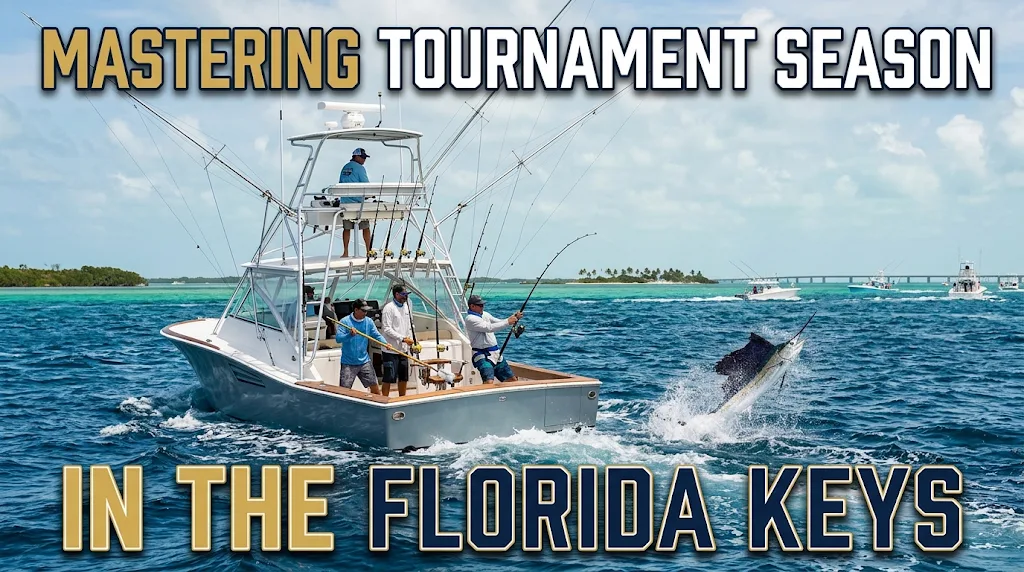
By Brian French, founder and publisher, Florida Authority Network
Islamorada markets itself as the sportfishing capital of the world, and the Florida Keys back that claim with a tournament calendar that runs nearly year-round. Sailfish dominate the winter and early spring. Tarpon take over Florida Bay and the bridges in late spring. Dolphin derbies fill the early summer, and big-game teams chase blue marlin off Key West in July. Between them are fly-only events for permit and tarpon, charity tournaments for flats guides, and a handful of invitational events that attract serious teams from around the country.
For a boat owner or captain, entering a Keys tournament is a project. It involves rigging, electronics, crew selection, rules compliance, travel planning and budgeting, long before the first line goes in the water. This guide walks through how experienced teams approach that work, and how the rules and conservation expectations shape what happens on tournament day. It draws on published tournament calendars and rules, and it uses 2026 events as examples, because the pattern tends to repeat year to year even when exact dates shift.
The Legacy and Structure of Keys Tournament Fishing
The Keys tournament scene grew out of a guide and charter tradition built around the Gulf Stream, which runs close to the islands and concentrates baitfish and billfish. Over time, local clubs, resorts and fishing guide associations built events around the seasons, and many are tied to charitable causes. A Keys event calendar published by a local newspaper summarizes the pattern well: most tournaments are catch-and-release, most have a charity component, and most book up months in advance.
Several events stand out. The Cheeca Lodge Presidential Sailfish Tournament in Islamorada has been described as the final leg of the three-part Florida Keys Gold Cup Sailfish Championship. The Fish for Holly Sailfish Tournament, held at the Islander Resort in Islamorada, held its eighth annual event on January 9 and 10, 2026 and describes itself as the largest sailfish tournament in the Keys. Key West’s offshore circuit includes the Key West Sailfish Tournament, the Viking Yachts Key West Challenge and the Key West Marlin Tournament. On the fly side, the Don Hawley Invitational Tarpon Fly Tournament returned to Islamorada in June 2026, and the long-running Gold Cup Tarpon Tournament marked its 63rd annual edition.
A Sample Year on the Keys Circuit
| Approximate window (2026) | Event type | Examples reported |
|---|---|---|
| January | Sailfish | Fish for Holly (Jan 9-10); Islamorada Women’s Sailfish Tournament (Jan 30-Feb 1) |
| Late January | King mackerel and wahoo | King Master Key West (Jan 30-31) |
| March and April | Sailfish and big-game | Key West Sailfish Tournament (Mar 26-28); Viking Yachts Key West Challenge (Apr 8-12) |
| April | Specialty | Spanish Fly Shark Tournament (Apr 2-4); Jeff Leonia Reel and Steel Classic (Apr 30-May 1) |
| June | Tarpon fly and dolphin | Don Hawley Invitational (Jun 1-5); Lower Keys Chamber Dolphin Tournament (Jun 5-7); Gator Club Dolphin Derby (Jun 12-14) |
| July | Marlin | Key West Marlin Tournament (Jul 22-25) |
Because dates move, always confirm the current year’s schedule with the organizer, and register early, since many teams fill their fields months ahead.
Vessel Preparation: Rigging for High-Stakes Fishing
Tournament preparation starts with the boat. Whether you run a center console or a custom sportfisher, the objective is the same: a vessel that is reliable for several consecutive fishing days in conditions that may be rough, with equipment that lets the crew work fast and safely.
Mechanical and safety readiness
- Service engines, generators and steering well before the event, and carry spare filters, belts and impellers.
- Inspect and test bilge pumps, navigation lights and required safety gear. Offshore events can be cancelled for weather, but boats are still expected to be ready.
- Check fuel capacity against the fishing area. Distances to productive water vary by tournament boundaries, and a long run to the stream and back consumes a lot of fuel.
- Confirm your communication plan, including VHF and a backup, because tournament directors and Coast Guard may use specific channels.
Live-well and bait management
Live bait is central to most billfish and dolphin strategies. Keep water circulating, monitor temperature and oxygen, and reduce stress on bait with proper handling. Many teams test their systems with a full load of bait before the event, because the first time a live well fails should not be at 6 a.m. on tournament day. A reliable bait supply plan, which may include buying bait from local suppliers or catching it before the event, is as important as any lure choice.
Electronics suite
Modern tournament boats typically carry multi-function displays with high-resolution chartplotting, sonar, radar, satellite sea-surface temperature overlays, and reliable GPS. Many teams also use tournament apps for live scoring and communication. Whatever you choose, learn it before the event. Features that are useful in a sales brochure are less useful if the crew cannot find them while a sailfish is on the line.
Tackle and rigging
Rod and reel selection depends on the species and the rules. Tournaments governed by International Game Fish Association (IGFA) angling rules specify line classes, leader lengths and other tackle limits. Fly-only events, such as the Don Hawley Invitational, which scores tarpon of at least four feet that are caught and released using 12-pound tippet in line with IGFA rules, impose even tighter limits. Review your event’s rules carefully before you rig.
Tournament Regulations and Conservation
Regulations are where many first-time teams lose points or get disqualified. Rules vary by event, but certain themes are common.
IGFA standards and tournament-specific exceptions
Many Keys tournaments base their rules on IGFA angling rules and then modify them. For example, the published rules for the Viking Yachts Key West Challenge in 2023 stated that IGFA rules apply with an exception to allow rod hand-offs, set fishing hours from 8:30 a.m. to 3:30 p.m., and set geographic boundary limits, with a mandatory captain’s meeting. One statewide format described in a tournament program noted that its rules were consistent with IGFA in some respects and different in others. The lesson is simple: read the event’s official rules and do not assume that a general IGFA standard answers your question.
Circle hooks and release requirements
Release-oriented tournaments commonly require circle hooks, and billfish rules are especially strict. The Viking Yachts Key West Challenge rules specified non-offset circle hooks for billfish and required all billfish to be released unharmed. Another tournament program noted that National Marine Fisheries Service rules require non-offset circle hooks in each tournament. Federal regulations governing Atlantic highly migratory species, which include billfish, also set requirements for permits, registration and reporting for certain tournaments, so organizers and participants should confirm what applies to their event with NOAA Fisheries.
Ethics and sportsmanship
Conservation expectations go beyond written rules. The IGFA Permit Invitational, a fly-only tournament, states that it is unsportsmanlike and a rules violation to have a spot saved by another boat, reflecting the fact that Keys waters are fished by many skiffs every day. Practical conservation habits include using a wet release whenever possible, minimizing time out of the water, reviving fish properly and keeping gear in good condition so lines and hooks do not fail.
Team Management and Strategy
Great tournament results usually come from teamwork rather than any single trick. A typical offshore team includes a captain, one or two mates, an angler or rotation of anglers, and sometimes a team manager who handles logistics and rules compliance.
Defining roles
- Captain: controls the boat, interprets sea conditions and decides where to fish.
- Mates: manage baits, rigs, leaders and fish handling, and often serve as the boat’s second pair of eyes for birds, weeds and current lines.
- Anglers: must understand rules about rod handling, hand-offs and fighting fish, which differ by tournament.
- Team manager or scorer: keeps release documentation, communicates with tournament officials and confirms that each fish is properly recorded.
Strategy across a series
Some events are standalone, while others feed into a series. A multi-event series such as the Florida Keys Gold Cup Sailfish Championship rewards consistency, so teams may manage fuel, crew fatigue and equipment wear differently than they would for a one-off event. Review the points system and any tie-breakers before the season begins.
Reading conditions
Successful captains study water temperature charts, current edges, wind direction and moon phase, and they talk to local guides and dock staff. They also respect weather limits. A tournament director can postpone or shorten a day, but a captain remains responsible for the boat and the people aboard.
The Economics of Tournament Fishing
Keys tournaments are also an economic engine. Entry fees, calcutta pools where permitted, sponsorships, dockage, fuel, bait, lodging and meals all flow into local businesses. Sponsor lists for community and charity tournaments illustrate how tackle makers, electronics manufacturers, marine retailers and conservation organizations rely on events to reach anglers. For example, a women’s tournament in Tavernier lists major sponsors that include marine electronics, apparel and tackle brands as well as a conservation foundation.
Budgeting for an entry
Costs vary widely, but owners should budget beyond the entry fee. A realistic plan includes fuel, bait, crew pay, dockage for the entire event, travel for the team, maintenance before and after, insurance review and contingency funds. Teams that fish several events often find that the real cost per tournament is dominated by logistics, not fees.
Chartering and marketing
Not every participant owns a boat. Many events welcome chartered teams, and charter captains use tournaments to showcase their skills. Businesses that sponsor or participate can benefit from visibility, but the best sponsorships are those that fit the tournament’s audience and conservation message.
A Pre-Season Checklist
- Choose events that fit your boat, crew and budget, and register early.
- Read the official rules in full, including hook, release, boundary and hand-off provisions.
- Confirm any federal or state permits or registrations required for your target species.
- Service the boat, test the live wells and update electronics software.
- Assign crew roles and run a practice day.
- Prepare documentation, including photos or video required for release verification.
- Plan your lodging, dockage and fuel logistics in advance.
The Keys offer competitive fishing at a world-class level, but the winners are rarely the teams with the most expensive boats. They are the teams that read the rules, prepare their equipment, work together and treat the fish with respect.
Frequently Asked Questions
What is the biggest sailfish tournament in the Florida Keys?
The Fish for Holly Sailfish Tournament in Islamorada describes itself as the largest sailfish tournament in the Keys, and the Cheeca Lodge Presidential Sailfish Tournament is described as the final leg of the Florida Keys Gold Cup Sailfish Championship.
Are Keys fishing tournaments catch-and-release?
Most are. A local events guide notes that most Keys tournaments are catch-and-release and have a charity component. Always check the specific event’s rules.
Do tournaments follow IGFA rules?
Many base their rules on IGFA standards but modify them. For example, one major Key West event allows rod hand-offs. Read the official rules for each tournament.
Do I need circle hooks for billfish tournaments?
Published rules for major Key West billfish events require non-offset circle hooks, and billfish must be released unharmed. Confirm the rules and any federal requirements for your event.
When is the Key West Marlin Tournament?
The 2026 event was held July 22 to 25. Dates change each year, so confirm with the organizer.
How early should I register for a Keys tournament?
Many events fill months ahead, so register as soon as registration opens and book dockage and lodging early.
About the Author
Brian French is the founder and publisher of the Florida Authority Network, a collection of more than 35 Florida business news, industry, video and press release publications. His career before publishing was in finance: he served as a Vice President and Trust Officer at both Merrill Lynch and SunTrust, and as a Portfolio Manager at Merrill Lynch Trust Company and Merrill Lynch Investment Managers – Private Investors. Earlier, he was a Financial Advisor at Shearson American Express and E.F. Hutton and a Common Stock Analyst at Independence Securities in Greensboro, North Carolina. He passed Level II of the CFA Program. Brian lives near Tampa, Florida, with his wife.
This article is general information for Florida boaters and marine businesses. It is not legal, tax, insurance or investment advice. Confirm current rules, fees and dates with the responsible agency or a licensed professional before you act.
Sources and Further Reading
- Visit Florida Keys, Florida Keys Fishing Tournaments: 2026 Tournament Highlights
- Visit Florida Keys, Don Hawley Tarpon Fly Tournament (June 1-5, 2026)
- Visit Florida Keys, 63rd Annual Gold Cup Tarpon Tournament
- Keys Weekly, Tell Your Next Fish Story With These 2025 Keys Tournaments
- Keys Weekly Events, Fishing Tournaments in the Florida Keys (FAQ)
- Key West Tourist, 2026 Key West Fishing Tournament Calendar
- Women’s Outdoor News, Your Next Big Catch Could Be at a Florida Keys Tournament (January 2026)
- Hunting Life, Fish for Holly Sailfish Tournament Set for Jan. 9-10 in Islamorada (December 29, 2025)
- ReelTime Apps, Viking Yachts Key West Challenge Tournament Rules (2023)
- IGFA, IGFA Permit Invitational tournament page
- Sports Destinations, Ladies, Let’s Go Fishing Screamin’ Reels Tournament, Tavernier
- Qualifying tournament program (Issuu), FAQ on circle hooks and IGFA rules
About the Author