By Brian French, founder and publisher, Florida Authority Network
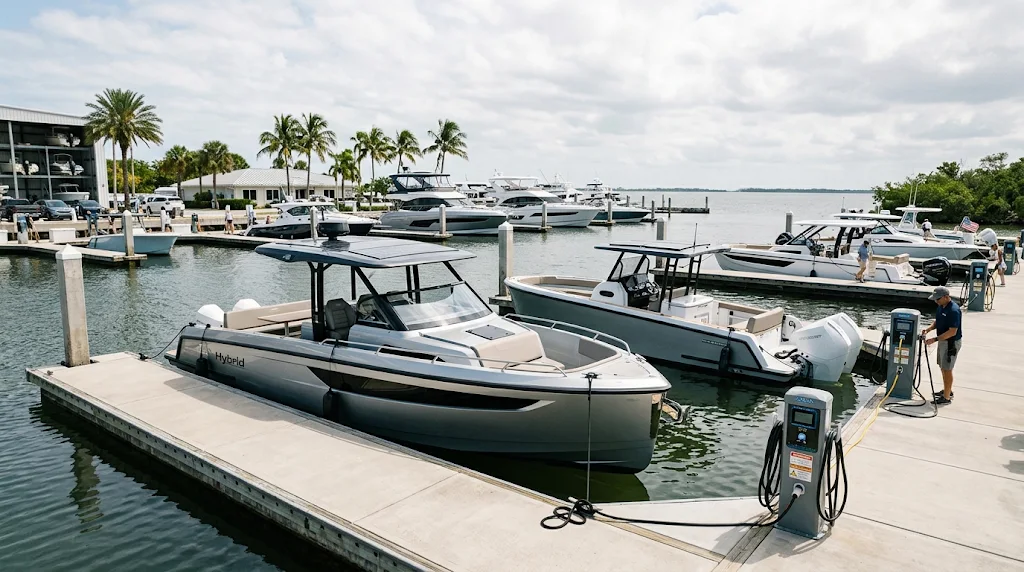
Electric propulsion has been a promise of the boating industry for years. In 2026, the promise is becoming a product category. Hybrid systems from major engine makers, fully electric outboards and inboards, purpose-built electric boats and dockside fast chargers are all on the market, and Florida, with its enormous boating population, year-round season and many marina operators, is one of the most important proving grounds. The shift is still early, and the technology has real limits, but owners, builders, marinas and commercial operators are making decisions now that will shape the fleet for the next decade.
This article explains how marine electrification works in practical terms: what batteries can and cannot do, how charging infrastructure is evolving at Florida marinas, where hybrid and electric boats are finding commercial success, and what to consider before you buy or retrofit. It relies on trade publications, manufacturer announcements and industry commentary, and it distinguishes between established facts and manufacturer claims.
Why Florida Is a Natural Market for Electric Boating
Florida combines several features that make electrification attractive. Much of its boating happens in protected, relatively short-range waters such as canals, rivers, bays and the Intracoastal Waterway. Many boats make short trips and then sit at a dock or lift for days, which is the usage pattern where overnight charging works well. Manatee zones, no-wake areas and sensitive estuaries also reward quiet, low-emission propulsion. And the state has an enormous population of dealers, marinas and marine technicians that can support a new technology if demand grows.
An executive at electric boat builder Voltari made a related point to public radio station WLRN in 2023, saying electric boats do not face the same charging challenge as electric cars because Florida slips already commonly have high-voltage shore power. That is a real advantage, but it comes with a caveat that marina operators repeatedly raise: having power at the slip is not the same as having enough capacity for many boats to charge at once.
Battery Technology and Range: What the Numbers Mean
Electric boats store energy in battery packs, typically lithium-ion chemistry adapted for the marine environment. The key figures to understand are capacity, measured in kilowatt-hours, and power, measured in kilowatts. Capacity determines how long you can run. Power determines how fast the boat can go.
Why boats are harder than cars
A car on a highway runs at a constant speed with relatively low resistance. A boat pushes water, and drag rises steeply as speed increases. That means a battery pack that gives a car hundreds of miles can give a boat a much shorter range at planing speeds. Electric boats are therefore most effective in displacement-speed cruising, short coastal runs, tenders and lakes, and less effective for long, fast offshore runs unless paired with a hybrid system.
Examples from the current market
- Flux Marine, working with boat builder Zodiac, announced a system with an 84 kWh battery pack that supports Level 1 or Level 2 charging at 30 amps as well as CCS DC fast charging, with a reported starting price of about $116,069 and pre-orders for 2026 delivery.
- Volvo Penta introduced a new hybrid propulsion system for yachts built around its D13 IPS drive in May 2026, one example of a major engine company offering hybrid options for larger vessels.
- Indmar has introduced a hybrid powertrain aimed at wake and surf boats, and Florida-based Genesis Marine Technologies launched the Genesis 24, which it describes as the first hybrid electric wake surf boat. The company claims 70 to 80 percent better fuel efficiency and four times the operating range of comparable conventional boats. Those are manufacturer claims, and buyers should ask for independent test data.
- Brunswick launched an electric brand, Veer, powered by its own Avatar propulsion system, as a sign that large incumbents are investing in the space.
Solar, Hybrid Parallel Systems and Range Extenders
Pure battery electric systems are not the only path. Hybrid systems combine a conventional engine with electric motors, and designs vary. In a parallel hybrid, the engine and electric motor can both drive the propeller, allowing low-speed electric operation in harbors and engine power for longer runs. In a series hybrid, the engine runs a generator that charges batteries and the electric motor does all the propulsion. Range extender engines are small generators that are used only when needed.
Solar panels can supplement house loads and extend range slightly, especially on boats with large flat surfaces. They rarely supply enough power for propulsion alone, but they can reduce generator use and keep batteries topped off at anchor. For many owners, the sweet spot is a hybrid or electric tender, auxiliary system or day boat rather than a complete replacement of a long-range cruiser’s diesel engines.
The Dockside Charging Grid
Charging is the second half of the electrification equation. Industry writers describe three broad levels of charging at marinas.
| Level | Typical use | Notes from industry sources |
|---|---|---|
| Level 1 and 2 (AC) | Overnight charging at the slip | Most marinas under construction already have enough capacity for overnight Level 2 charging for boats that go out once or twice a week |
| DC fast charging | Short stays, commercial turnarounds | Can deliver up to 250 to 350 kW; a panel at a marina conference noted a DC charge may take at least an hour to top off a boat |
| Shore power pedestals (50 or 100 amp) | Existing marina infrastructure | Some electric boats are designed to use standard marine pedestals for overnight charging |
Fast charging networks
AQUA superPower has developed fast-charging stations designed for the marine environment, with AC and DC charging and a maximum output of 150 kW, and it works with marinas and electric boat makers on installations in Europe and the United States. Evoy, a Norwegian electric propulsion company, offers DC fast charging as part of its standard systems and has described using a Kempower charger with 40 kW of power at a commercial operator to rotate boats between charging and operating. Voltari says its patrol boat series supports Level 2 and DC fast charging through a J1772 and CCS1 interface, and can complete an overnight charge from standard marine pedestals.
What marinas are worried about
Marina trade publications point to several operational concerns. Charging electric boats can strain a marina’s electrical service if many boats plug in at once, so load-sharing technology, already used in home EV charging, will become important. Dry stack facilities may need to store electric boats on lower levels where charging equipment is accessible. Marina staff will need training in handling high-voltage systems, and service departments will need technicians who understand batteries and controllers. A Florida Trend report noted that marinas sometimes already have adequate shore power, but that increasing capacity as quickly as electric boat market share grows could be an issue.
Marina owners also have to think about how they will bill for electricity, how long boats will occupy fast-charging berths and what amenities customers will want while their boats charge. Industry panels have pointed out that, unlike a quick refuel at a gas dock, a fast charge may take an hour or more, so facilities have to plan for dwell time.
Commercial and Recreational Adoption
The most compelling use cases for electric and hybrid propulsion are those with predictable routes, daily turnarounds and strong incentives to reduce noise and emissions.
Commercial operators
Short-route passenger boats, tour operators, harbor workboats, patrol craft and ferries can be good candidates because they run a known schedule and return to a fixed charging point. The Tampa Bay region’s planned ferry service, for instance, will use a new passenger vessel funded in part by a federal grant, illustrating the sort of public transit boat project that could, in time, include electrification. Patrol and workboat makers are also targeting government customers who value quiet operation and lower fuel costs.
Recreational boaters
For recreational owners, the first adopters tend to be those who use tenders, day boats and wake boats near home waters, and those with strong environmental motives or access to a charging-friendly slip. A dealer group principal who operates seven Florida dealerships and has invested in electric boats has been quoted in trade coverage as working to overcome obstacles to sales, including customer unfamiliarity and price. Electric boats also tend to cost more than comparable gasoline boats, so the economic case depends on fuel and maintenance savings over time.
Luxury yachts and tenders
Superyacht builders and tender makers are adding electric tenders and hybrid propulsion to improve comfort and reduce noise at anchor. A hybrid yacht can run silently on batteries when anchored, powering air conditioning and hotel loads without a generator. That experience is hard to match with conventional systems, and it is one of the most visible selling points at big shows.
What to Consider Before You Buy or Retrofit
- Define your use pattern. How far do you go, how fast do you run and how often do you use the boat?
- Check your charging options. Confirm the amperage and voltage at your slip, lift or home dock, and ask your marina about charging policies.
- Understand the warranty. Ask about battery degradation, replacement cost and what is covered if the battery is damaged by water or heat.
- Ask for independent data. Manufacturer range claims often assume ideal conditions. Look for test results from independent boat testers.
- Plan for service. Find out where the nearest certified technician is and how long parts take to arrive.
- Review insurance. Some insurers have specific requirements for lithium battery systems, and underwriters may ask about installation standards and fire protection.
- Consider resale. The market for used electric boats is still developing, so residual values are uncertain.
Safety Considerations
High-voltage systems require professional installation and adherence to marine electrical standards. Lithium batteries can pose fire risks if damaged, overcharged or improperly installed, and fires in confined boat spaces are hard to fight. Owners should insist on battery management systems, proper ventilation or thermal management where specified, and installation by qualified technicians. Marinas should review their emergency plans and fire protection with local fire departments so crews know how to respond to a battery incident.
Regulatory and Incentive Outlook
Incentives for clean marine technology have shifted over recent years at both state and federal levels, and rules and eligibility criteria can change. Some programs target commercial operators, others focus on ports and infrastructure, and many are competitive grants rather than guaranteed tax credits. This article does not attempt to list current programs because eligibility and funding levels change often. Owners and operators who are considering electric retrofits should ask a qualified tax professional and the relevant agency about the current status of any incentives before assuming they will apply.
At the infrastructure level, marinas planning charging projects should check local building and electrical code requirements, utility interconnection rules and any environmental permitting needed for new docks or utility corridors. Early conversations with the local utility can prevent surprises about service upgrades.
The Outlook
Electric and hybrid boating will not replace conventional propulsion overnight. Range, charging time, cost and service networks remain real barriers, especially for offshore and high-speed use. But the direction is clear. Engine makers are launching hybrid products, startups are building purpose-designed electric boats, charging companies are installing marine-specific fast chargers, and marinas are learning how to host electric fleets. The people who will benefit most in the near term are the ones whose usage patterns match the technology, including commercial operators with fixed routes, owners of tenders and day boats and marinas that plan their electrical capacity early.
Frequently Asked Questions
Are electric boats practical in Florida?
For short-range, lower-speed use near home waters, yes. Florida marinas often have high-voltage shore power available, but range at planing speeds and charging capacity at crowded marinas remain limits.
How long does it take to charge an electric boat?
It depends on battery size and charger type. Overnight Level 2 charging is common for boats that go out once or twice a week, while DC fast charging is faster but may still take at least an hour to top off a boat, according to industry panelists.
What is the difference between hybrid and electric boats?
A fully electric boat uses only batteries and motors. A hybrid combines a conventional engine with electric motors or a generator, providing longer range and the option to run silently on batteries at low speeds.
Do marinas need special equipment for electric boats?
Many can start with existing shore power pedestals for overnight charging, but marinas expecting many electric boats may need electrical upgrades, load-sharing systems, DC fast chargers and staff training.
Are manufacturer range claims reliable?
Treat them as starting points. Claims such as improved fuel efficiency and operating range depend on test conditions, so ask for independent test results and real-world data.
Are there incentives for electric boat retrofits?
Programs exist but change frequently and often target commercial or infrastructure projects. Confirm current eligibility with a tax professional or the administering agency.
About the Author
Brian French is the founder and publisher of the Florida Authority Network, a collection of more than 35 Florida business news, industry, video and press release publications. His career before publishing was in finance: he served as a Vice President and Trust Officer at both Merrill Lynch and SunTrust, and as a Portfolio Manager at Merrill Lynch Trust Company and Merrill Lynch Investment Managers – Private Investors. Earlier, he was a Financial Advisor at Shearson American Express and E.F. Hutton and a Common Stock Analyst at Independence Securities in Greensboro, North Carolina. He passed Level II of the CFA Program. Brian lives near Tampa, Florida, with his wife.
This article is general information for Florida boaters and marine businesses. It is not legal, tax, insurance or investment advice. Confirm current rules, fees and dates with the responsible agency or a licensed professional before you act.
Sources and Further Reading
- WLRN, Cleaner Fuels, Electric Power Generate Growing Interest at Miami Boat Show (February 2023)
- Marina Dock Age, articles on serving electric-powered boats, charging levels and marina preparation
- Florida Trend, Business Beat: electric boats and marina shore power
- Trade Only Today, An Electrifying Future
- Trade Only Today, Panel discussion at the Association of Marina Industries Conference and Expo on electric boats
- Boattest.com, Evoy DC Fast Charging for Electric Boats
- Boattest.com, AQUA superPower: Power in the Future
- Charged EVs, Voltari Unveils Patrol 26 RIB Electric Patrol Boat Series
- Charged EVs, Flux Marine and Zodiac electric propulsion announcement
- BoatUS (GEICO Marine), Whatever Floats Your Boat (May 2026)
- Southern Boating, Volvo Penta Unveils New D13 IPS Hybrid Yacht Propulsion System (May 12, 2026)
- Professional BoatBuilder, The Electric Propulsion Turn-On (2024)
- FOX 13 Tampa Bay, U.S. Transportation Secretary Sean Duffy Announces Port Tampa Bay Investment (ferry funding)
About the Author